
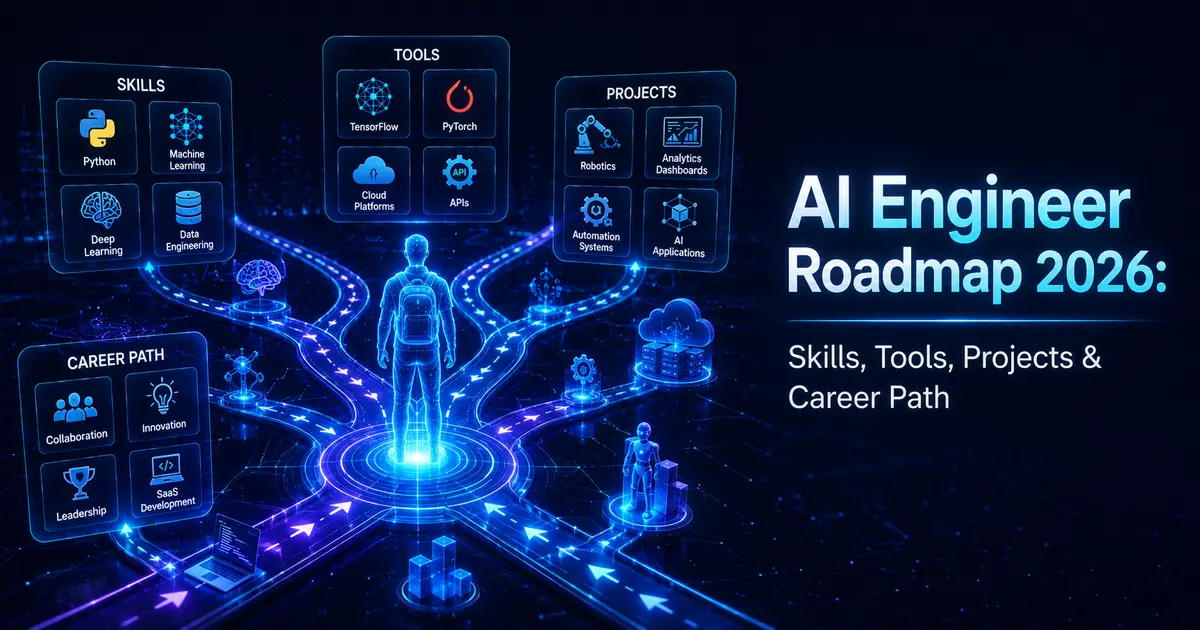
An AI Engineer Roadmap is a structured path that takes you from programming fundamentals to building and deploying real AI-powered applications — covering LLM APIs, prompt engineering, retrieval-augmented generation, agents, evaluation, and production deployment. It’s a different path from a classic machine learning roadmap, and mixing the two up is still the biggest reason beginners feel lost in 2026.
This guide lays out a complete AI Engineer Roadmap: the skills stack, the tools employers actually use right now, realistic timelines, and the portfolio projects that get interviews — whether you’re coming from software development, data science, or starting fresh.
What Is an AI Engineer Roadmap?
An AI Engineer Roadmap sequences the skills needed to build real AI products — not just call a model, but connect it reliably to applications people actually use. That means APIs, prompt design, retrieval systems, agent frameworks, evaluation pipelines, and deployment, layered on top of solid software engineering fundamentals.
By 2026, “AI engineer” has gone from a loose title anyone with an API key could claim to a role with a real bar: hiring managers now expect production deployment experience, evaluation discipline, and cost control — not just a working demo.
AI Engineer vs. Machine Learning Engineer vs. Data Scientist
These three roles overlap but solve different problems. Here’s how the AI Engineer Roadmap diverges from these adjacent roles.
| Role | Primary Focus | Core Skills |
|---|---|---|
| AI Engineer | Building applications on top of existing foundation models | APIs, prompt engineering, RAG, agents, evaluation, deployment |
| ML Engineer | Training, tuning, and scaling models | Model architecture, training pipelines, MLOps |
| Data Scientist | Extracting insights and predictions from data | Statistics, experimentation, classical ML |
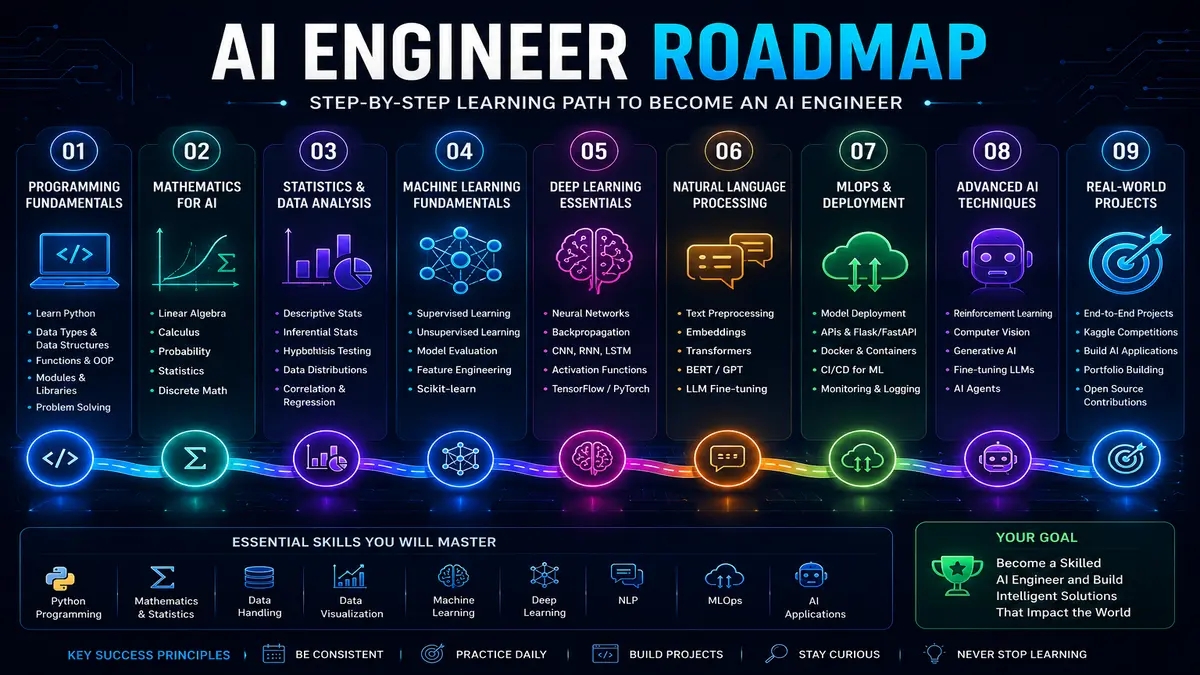
The AI Engineer Roadmap: Step-by-Step
Follow these stages in order. Trying to build agents before you’re comfortable with APIs and evaluation is still the most common way learners stall out — and in 2026, skipping evaluation specifically is the new version of that mistake.
| Stage | Focus | Estimated Duration |
|---|---|---|
| 1. Programming Foundations | Python, APIs, Git, basic data structures | 4–6 weeks |
| 2. LLM Fundamentals | How LLMs work, tokens, context windows, embeddings | 3–4 weeks |
| 3. Prompt Engineering | Structured prompting, few-shot examples, chain-of-thought, ReAct | 3–4 weeks |
| 4. Retrieval-Augmented Generation (RAG) | Vector databases, embeddings, retrieval pipelines, reranking | 6–8 weeks |
| 5. Evaluation & Observability | RAGAS-style scoring, tracing, regression testing for AI quality | 2–3 weeks |
| 6. AI Agents & Orchestration | Tool use, function calling, LangGraph/CrewAI, MCP, guardrails | 6–8 weeks |
| 7. Deployment & MLOps | Docker, cloud hosting, monitoring, cost management | 4–6 weeks |
| 8. Portfolio & Job Prep | Real projects, GitHub, resume, interviews | Ongoing |
Realistic total: 6–12 months of consistent study, depending on prior programming experience.
Want to go deeper on agents specifically? Read our guide: What Are AI Agents? 9 Powerful Facts Every Beginner Must Know.
Core Skills You’ll Need
Every AI Engineer Roadmap lives or dies on this section — the frameworks change yearly, but these underlying skills don’t.
Programming and APIs
Python remains the default language, but comfort with REST APIs and JSON matters just as much as the language itself. A simple example of calling an LLM API:
import requests

response = requests.post(
    "https://api.example-llm.com/v1/complete",
    headers={"Authorization": "Bearer YOUR_API_KEY"},
    json={"prompt": "Summarise this article in 3 bullet points.", "max_tokens": 200}
)
print(response.json()["completion"])
Prompt Engineering and RAG
Prompt engineering — structuring inputs to reliably get the output you want — is still a core, teachable skill. In 2026, this extends into agentic prompting: reasoning-loop patterns like ReAct (reason, act, observe, repeat) and forcing structured JSON output so downstream code can parse it reliably.
Retrieval-Augmented Generation (RAG) grounds model responses in your own data using a vector database, reducing hallucinations significantly. The frontier has moved to Agentic RAG: instead of a single search-and-summarize pass, the system checks whether retrieved context is actually sufficient and re-searches or looks elsewhere if not.
Evaluation and Observability (New for 2026)
This is the stage most AI Engineer Roadmap guides still skip — and the one that separates a demo from something a company will trust in production. Without it, you can’t answer “is this actually working?” with anything other than a guess.
- Evaluation metrics — faithfulness (is the answer grounded in retrieved context?), relevancy, and context recall, often scored with frameworks like RAGAS
- Tracing — logging every LLM call, retrieval step, and agent action so you can debug failures after the fact
- Regression testing — catching quality drops before they reach users, the same way unit tests catch code regressions
Tools and Frameworks for the AI Engineer Roadmap
| Category | Recommended Tools |
|---|---|
| Programming | Python, JavaScript/TypeScript |
| LLM Providers | OpenAI, Anthropic, Hugging Face models |
| Agent Frameworks | LangGraph, LangChain, CrewAI, PydanticAI |
| Vector Databases | Pinecone, Qdrant, Weaviate, Chroma, pgvector |
| Evaluation & Observability | RAGAS, Langfuse, LangSmith, Phoenix |
| Deployment | Docker, AWS, Vercel, FastAPI |
| Interoperability Standards | Model Context Protocol (MCP), Agent2Agent (A2A) |
A quick note on agent frameworks, since this is where most 2026 confusion lives: LangGraph is generally the choice for production systems where a failure costs money or reputation (it gives you explicit control over state and control flow). CrewAI is faster for quickly automating straightforward business workflows. PydanticAI is the emerging pick for teams that want strong type guarantees. LangChain is still worth learning as the connective-tissue layer and because it makes LangGraph easier to pick up afterward — but it’s no longer the whole story on its own.
Guardrails and Reliability (New for 2026)
No AI Engineer Roadmap is complete without this. As agents get more autonomous, defending against prompt injection and building in guardrails (input/output validation, tool-call validation before execution, timeouts, retry logic with backoff, cost caps) has become a standard part of the job — not an afterthought bolted on before shipping.
Fine-Tuning (Optional, But Worth Knowing)
Full fine-tuning of large models is prohibitively expensive for most teams. Parameter-efficient fine-tuning — specifically LoRA and QLoRA — lets you adapt a smaller model to a specialized task on a single GPU. You don’t need this to get hired, but knowing when fine-tuning actually beats well-engineered prompting (less often than people assume) is a useful signal in interviews.
Building a Portfolio That Gets Interviews
This is where the AI Engineer Roadmap pays off. Employers hiring AI Engineers want to see working applications, not just notebooks. Prioritize projects that show you can ship something real and that you understand it as a system, not just a library call.
- Build a RAG-based chatbot over a real, messy document set (not a toy dataset)
- Deploy at least one project publicly with a live demo link
- Build an AI agent that uses at least one external tool or API, with basic guardrails
- Add an evaluation layer to one project — even a simple RAGAS-style faithfulness check
- Document your architecture decisions clearly in your GitHub README
Common Mistakes on the AI Engineer Roadmap
- Confusing the AI Engineer Roadmap with a classic ML engineering path focused on training models from scratch
- Skipping prompt engineering fundamentals and jumping straight to complex agent frameworks
- Skipping evaluation entirely — the most common 2026-specific mistake
- Ignoring deployment and cost management until it’s too late to matter
- Building projects with toy data instead of realistic, messy use cases
- Learning AutoGen because it’s what search results show, rather than what teams are shipping with today
Best Practices for Following the AI Engineer Roadmap
- Learn one LLM provider deeply before comparing across multiple providers
- Track token usage and API costs from your very first project
- Rebuild at least one tutorial project independently to confirm real understanding
- Learn one agent framework deeply (LangGraph is the safest default) before sampling others
- Stay current — this field changes faster than classical software engineering
Career Paths After Completing the AI Engineer Roadmap
| Role | Focus | Typical Entry Point | Typical Salary Range (US) |
|---|---|---|---|
| AI-Augmented Software Engineer | Integrating AI features into existing products | Existing SWE background + basic LLM API skills | $120K–$160K |
| AI Engineer | Building AI-native applications and agents from scratch | After RAG + agent + evaluation fundamentals | $130K–$220K |
| Machine Learning Engineer | Training and scaling custom models | Requires deeper ML theory | Varies widely by seniority |
| AI Product Engineer | Bridging product design and AI implementation | Strong product + technical hybrid skills | $140K–$220K+ |
| MLOps Engineer | Deployment, monitoring, and infrastructure for AI systems | Strong DevOps + ML foundations | $140K–$220K+ |
Ranges are directional, not guarantees — they vary heavily by company stage, location, and level.
Future Trends Shaping the AI Engineer Roadmap
The Model Context Protocol from Anthropic has moved from emerging to established: it’s now a genuine enterprise standard for connecting agents to tools, and engineers who can build MCP servers (not just call them) are still a small minority of the workforce, which makes it a real differentiator. Alongside it, the Agent2Agent (A2A) protocol is gaining traction for letting agents from different vendors communicate with each other. Providers like OpenAI continue expanding native agent and tool-calling capabilities, and cloud platforms such as AWS are investing heavily in managed infrastructure specifically for deploying AI applications at scale.
Key Takeaways
- An AI Engineer Roadmap focuses on building applications with existing AI models, not training models from scratch.
- It’s distinct from both a Machine Learning Engineer and a Data Scientist roadmap.
- Python and comfort with REST APIs are still the two non-negotiable starting skills.
- Prompt engineering and RAG form the practical core, but evaluation and observability are now equally core, not optional extras.
- Vector databases and embeddings are essential for grounding AI outputs in real data — know at least two of Pinecone, Qdrant, Weaviate, or pgvector.
- LangGraph has emerged alongside LangChain as the production standard for agent orchestration; CrewAI and PydanticAI are the notable alternatives.
- The Model Context Protocol (MCP) is now an established standard; Agent2Agent (A2A) is the one to watch next.
- Guardrails and prompt injection defense are now standard interview topics, not afterthoughts.
- Deployment, monitoring, and cost management matter as much as building the model logic.
- A deployed, working project with an evaluation layer beats a stack of local notebooks in interviews.
- Skipping fundamentals and jumping straight to agents — or skipping evaluation entirely — are the two most common roadmap mistakes in 2026.
- Career paths branch into AI-Augmented Software Engineer, AI Engineer, ML Engineer, AI Product Engineer, and MLOps Engineer roles.
Key Glossary
- AI Engineer
- A professional who builds and deploys applications powered by AI models.
- Large Language Model (LLM)
- A model trained on text data that powers modern AI applications.
- Prompt Engineering
- Designing inputs to guide an LLM toward better, more reliable outputs.
- Agentic Prompting
- Reasoning-loop prompting patterns (e.g., ReAct) used to drive multi-step agent behavior.
- Retrieval-Augmented Generation (RAG)
- Combining a knowledge source with an LLM to ground its answers in real data.
- Agentic RAG
- RAG that actively checks whether retrieved context is sufficient and re-searches if not.
- Vector Database
- A database optimised for storing and searching embeddings.
- Embeddings
- Numerical representations of text used to measure semantic similarity.
- Token
- A chunk of text an LLM processes; usage is often billed per token.
- Context Window
- The amount of text an LLM can consider at once.
- AI Agent
- A system that uses an LLM to reason, plan, and take multi-step actions autonomously.
- Function Calling / Tool Use
- A structured way for an LLM to invoke a specific tool with parameters.
- Model Context Protocol (MCP)
- An open standard connecting AI agents to external tools and data.
- Agent2Agent (A2A)
- An emerging protocol for cross-vendor agent-to-agent communication.
- LangChain
- A framework for connecting LLM components like models, prompts, and parsers.
- LangGraph
- A framework built on top of LangChain for stateful, production-grade agent workflows.
- Evaluation (Evals)
- Systematic measurement of whether an AI system’s outputs are actually good.
- RAGAS
- A framework for scoring RAG system quality (faithfulness, relevancy, context recall).
- Observability (LLMOps)
- Tracing and monitoring LLM calls, retrieval steps, and agent actions in production.
- Guardrails
- Validation and safety checks around model inputs/outputs and tool calls.
- Prompt Injection
- An attack where malicious input tries to override an AI system’s intended instructions.
- Fine-Tuning
- Further training a model on specific data to specialise its behaviour.
- LoRA / QLoRA
- Parameter-efficient fine-tuning methods that adapt a model without full retraining.
- API
- An interface that lets software systems, including AI models, communicate.
- Hallucination
- When a model generates incorrect or fabricated information.
- MLOps
- Practices for deploying and maintaining machine learning models reliably in production.
- Deployment
- Making a trained model or application available for real-world use.
- Docker
- A tool for packaging applications into portable, consistent containers.
- Cloud Hosting
- Running applications on remote servers provided by a cloud platform.
- Machine Learning Engineer
- A professional focused on training, tuning, and scaling ML models.
- Data Scientist
- A professional focused on extracting insights and predictions from data.
- Semantic Search
- A search method that matches meaning rather than exact keywords.
- Chain-of-Thought Prompting
- A technique where a model reasons step by step before answering.
- Multi-Agent System
- Multiple specialised AI agents collaborating on a shared goal.
- Cost Management (AI)
- Tracking and optimising token and compute spend in AI applications.
Frequently Asked Questions
Conclusion
The AI Engineer Roadmap turns a fast-moving, easily confused field into a clear, ordered path — programming foundations, LLM fundamentals, prompt engineering, RAG, evaluation, agents, and deployment, in that order. Focus on shipping real, deployed, evaluated projects rather than collecting tutorials, and keep learning consistently since this space evolves faster than most. Ready to start? Follow the stages above in order, and revisit this AI Engineer Roadmap as you build out your first projects.