

AI Agents are autonomous software systems that can observe, decide, and act on their own to complete tasks with little human input. If you have used a tool that books, researches, or codes for you instead of just answering questions, you have already met an AI Agent. This complete beginner’s guide explains what AI Agents are, how they work, their main types, and real examples used across industries worldwide.
What Are AI Agents?
AI Agents are programs that combine a reasoning engine with memory and tools so they can pursue a goal rather than simply reply to a prompt. Unlike traditional software that follows fixed rules, an agent can plan, adapt, and decide its next step based on feedback.
Most modern agents are built on large language models, which give them the ability to understand instructions, break a goal into steps, and call external tools to get things done.
How AI Agents Work
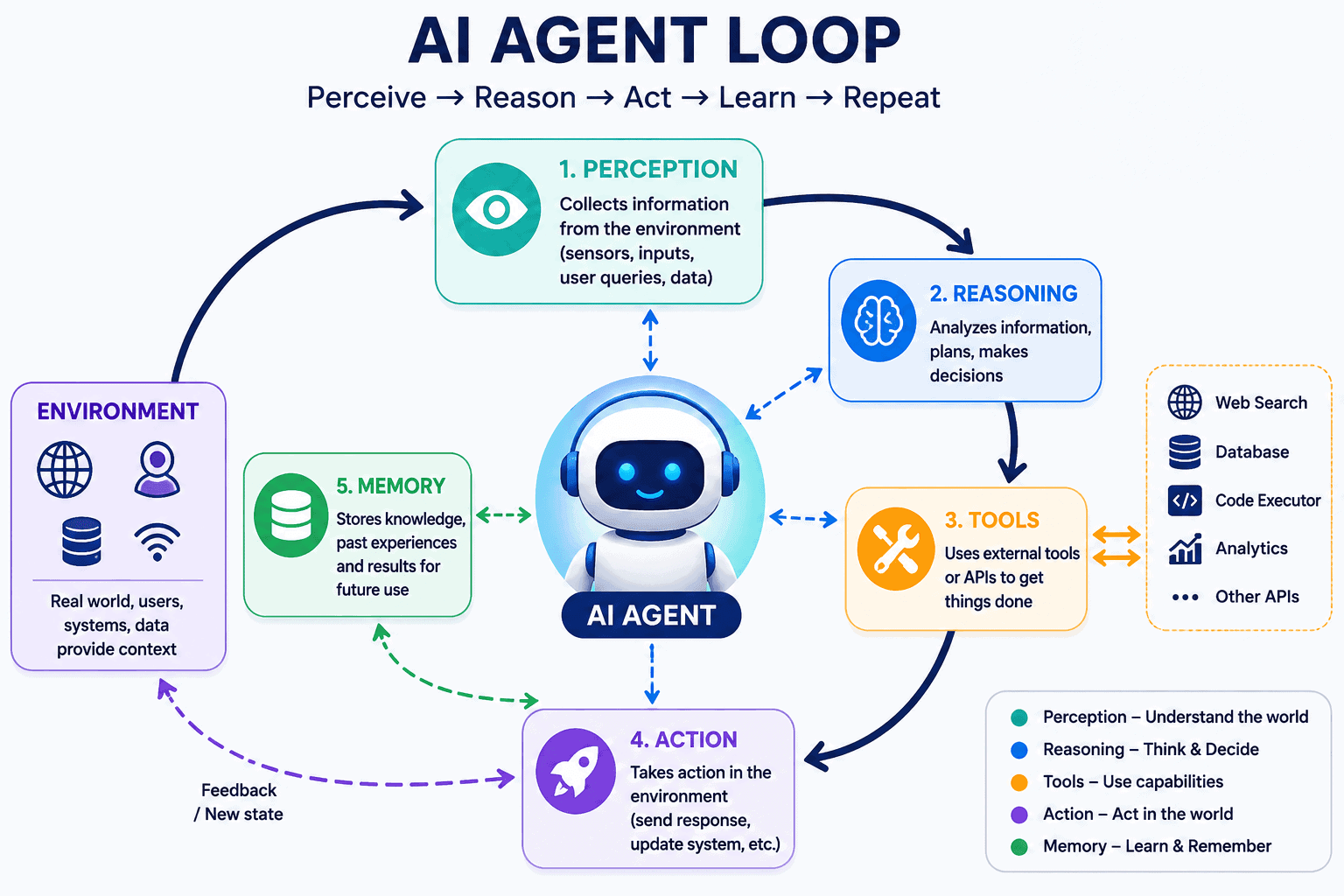
Every agent follows a simple loop: it senses its environment, reasons about what to do, acts, and then learns from the result. These four stages repeat until the goal is reached.
Perception
The agent gathers input from users, documents, APIs, databases, or sensors. This is the information it will reason about.
Reasoning and Planning
The reasoning engine interprets the goal, breaks it into smaller steps, and decides the best order to complete them. This is where large language models add the most value.
Memory
Memory lets the agent remember earlier steps, user preferences, and long-term context, so it does not start from zero on every action.
Action and Tools
The agent executes its plan by calling tools such as search, code execution, or third-party applications, then evaluates whether the result moved it closer to the goal.
while not goal_reached:
    observation = perceive(environment)
    plan = reason(observation, memory)
    result = act(plan, tools)
    memory.update(result)
    goal_reached = evaluate(result)
Types of AI Agents
Agents range from very simple rule-followers to advanced systems that learn over time. Understanding the main types helps you choose the right approach for a task.
Simple Reflex Agents
These react directly to the current input using fixed rules and keep no memory. They work well in predictable, stable environments.
Model-Based Agents
These maintain an internal model of the world, so they can make better decisions even when they cannot see everything at once.
Goal-Based Agents
Goal-based agents evaluate possible actions against a desired outcome and choose the path most likely to reach it.
Utility-Based Agents
These go a step further and select the action that maximises overall value or “utility” when several goals compete.
Learning Agents
Learning agents improve continuously by using feedback and experience, which makes them ideal for changing environments.
AI Agents vs Traditional Chatbots
The clearest way to understand them is to compare these agents with traditional chatbots, which mostly respond to messages without taking real action.
| Feature | AI Agents | Chatbots |
|---|---|---|
| Memory | Yes | Limited |
| Planning | Advanced | None |
| Tool use | Yes | Rare |
| Autonomy | High | Low |
| Task execution | Yes | Mainly replies |
Why AI Agents Are Different
Traditional chatbots respond to prompts, while agents can analyse a goal, create a plan, execute actions, and judge the results. That shift from answering to doing is what makes them so powerful.
Real Examples of AI Agents
Agents are already used across industries worldwide. These examples show how the same core idea applies to very different problems.
- Customer support: agents resolve tickets, fetch order details, and escalate complex issues.
- Software development: coding agents write, test, and debug code from a plain-language request.
- Research: agents gather sources, summarise findings, and compile reports.
- Operations: agents monitor systems, detect anomalies, and trigger fixes automatically.
You can read the original research that popularised tool-using language models from the ReAct paper, and explore popular open frameworks such as LangChain and the wider ecosystem documented by OpenAI.
[INTERNAL LINK: Agentic AI Explained → your future Agentic AI overview post]
[INTERNAL LINK: Large Language Models Guide → your LLM beginner post]
[INTERNAL LINK: Machine Learning Basics → your ML beginner post]
Benefits and Risks of AI Agents
Agents offer major gains in speed and automation, but they also bring real risks that teams must manage carefully.
- Benefits: automate multi-step work, operate around the clock, and scale across tasks.
- Risks: they can act on wrong information, make unsafe decisions without guardrails, or raise privacy concerns.
Key Takeaways
- Autonomous systems that perceive, reason, and act toward a goal.
- They combine large language models, memory, planning, and tools.
- They differ from chatbots by executing tasks, not just replying.
- The main types are reflex, model-based, goal-based, utility-based, and learning agents.
- They are used worldwide in support, coding, research, and operations.
- Clear goals and strong guardrails are essential for safe results.
Key Glossary
- AI Agent
- An autonomous software system that perceives, reasons, and acts to reach a goal.
- Reasoning Engine
- The component that interprets a goal and plans the steps to achieve it.
- Memory
- Stored context and history the agent uses to make better decisions.
- Tool Use
- The agent’s ability to call external functions, APIs, or applications.
- Multi-Agent System
- Several agents collaborating to solve a larger problem.
Frequently Asked Questions
Conclusion
AI Agents represent a major step beyond traditional software, because they can reason, plan, remember, and act toward real goals. As organisations worldwide adopt them across support, coding, research, and operations, understanding how AI Agents work — and how to keep them safe — becomes an essential skill. Keep learning about AI, automation, and agentic systems to stay ahead in this fast-moving field.