

A Prompt Engineering Guide is only useful if it shows you techniques that actually change model output — not just a list of buzzwords. This Prompt Engineering Guide covers the core techniques, the reasoning behind why they work, and real, runnable examples you can apply directly to any LLM, whether you’re using OpenAI, Anthropic, or Google’s models.
You’ll learn the core prompting techniques, how to structure a system prompt properly, the most useful frameworks for consistent results, and the mistakes that quietly ruin otherwise good prompts. If you’re mapping this against a broader learning path, this Prompt Engineering Guide covers Stage 3 of our AI Engineer Roadmap.
What Is Prompt Engineering?
Prompt engineering is the practice of structuring instructions, context, and examples so a language model produces accurate, consistent, and useful output. It matters because the same model can produce dramatically different quality results depending purely on how a request is worded and structured.
Why Prompt Structure Changes Output Quality
This section of the Prompt Engineering Guide covers the mechanics behind it. LLMs predict the most likely next token based on everything in the context window. Clearer structure, explicit constraints, and relevant examples all narrow that prediction toward what you actually want — vague prompts leave far more room for the model to guess wrong.
Here’s what that looks like in practice:
| Vague Prompt | Structured Prompt |
|---|---|
| “Write something about our product for social media.” | “Write 3 LinkedIn post variations (under 60 words each) announcing our new dashboard feature. Tone: confident, not salesy. Include one concrete metric from the notes below.” |
| Result: generic, inconsistent length, tone drifts between posts. | Result: consistent length, one clear metric anchored per post, tone stays stable across variations. |
Nothing about the model changed between those two prompts — only the amount of ambiguity did. That’s the entire premise this Prompt Engineering Guide is built on: quality is largely a function of how much guesswork you leave the model to do.
Core Prompt Engineering Techniques
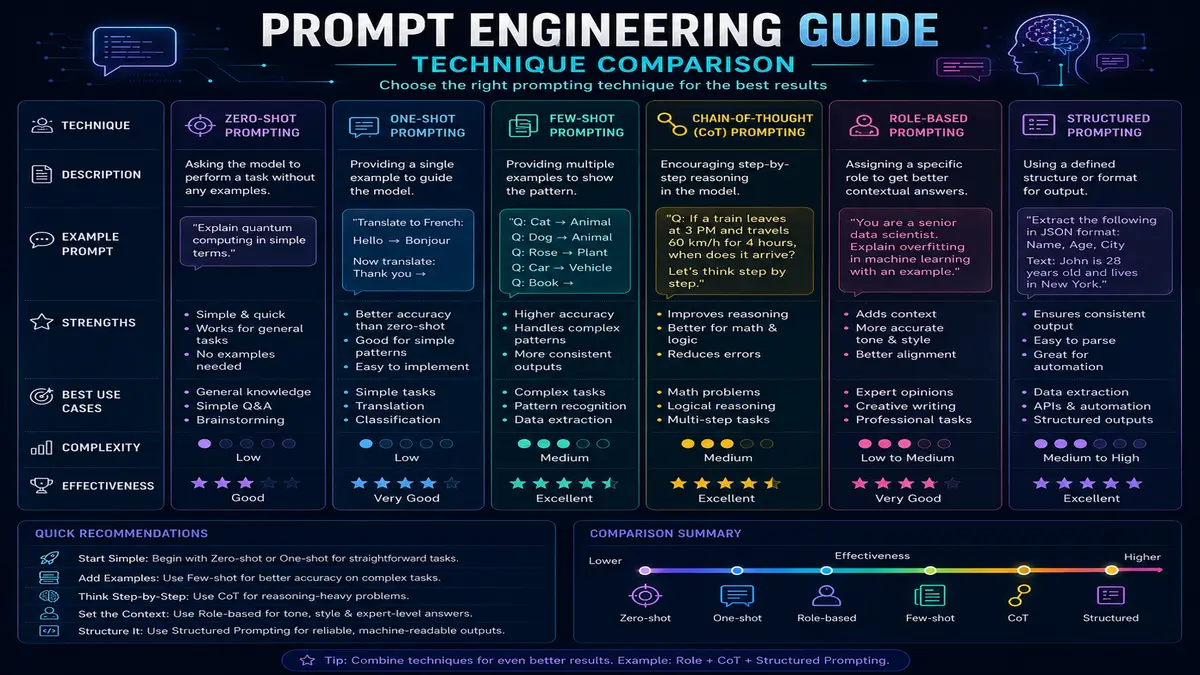
Following this Prompt Engineering Guide means knowing which technique fits which problem. Here’s a direct comparison.
| Technique | Best For | Example Use |
|---|---|---|
| Zero-shot prompting | Simple, well-known tasks | “Translate this sentence to French.” |
| Few-shot prompting | Tasks needing a specific format or style | Providing 2–3 example input/output pairs |
| Chain-of-thought | Multi-step reasoning problems | “Think step by step before answering.” |
| Role prompting | Setting tone, expertise, or perspective | “You are a senior data scientist…” |
| Structured output prompting | Predictable, parseable formats | Requesting JSON with a defined schema |
Want to go deeper on this? Read our guide: What Are AI Agents? 9 Powerful Facts Every Beginner Must Know.
Writing an Effective System Prompt
Every practical Prompt Engineering Guide needs this section, since the system prompt is where most consistency problems actually get solved. A good system prompt sets role, tone, constraints, and output format before the user’s actual request. A minimal but effective example:
system_prompt = """
You are a technical writing assistant for an AI and data science blog.
Always respond in clear, concise language.
Never use filler phrases or unnecessary repetition.
When asked for code, return only valid, runnable examples.
"""

user_prompt = "Explain gradient descent in 3 sentences."
Chain-of-Thought in Practice
Adding a simple instruction like “reason step by step before giving your final answer” measurably improves accuracy on multi-step problems, especially maths, logic, and multi-part instructions.
Advanced Prompt Engineering Techniques
Once the core techniques feel routine, these three go further — they’re less commonly covered, but they solve real reliability problems in production systems.
Self-Consistency
Instead of asking a model for one chain-of-thought answer, generate several independent reasoning paths for the same question and take the majority answer. It costs more tokens, but for problems with a single correct answer — math, logic, classification — it measurably reduces the rate of confident-but-wrong outputs.
Prompt Chaining
Rather than cramming a complex task into one prompt, break it into sequential steps where each output feeds the next input: draft, then critique, then revise, for example. Each individual prompt stays simple and easy to debug, and you can inspect the intermediate output when something goes wrong instead of guessing which part of one giant prompt failed.
Meta-Prompting
Use the model itself to improve your prompt: ask it to critique a draft prompt for ambiguity, missing constraints, or edge cases it doesn’t handle, then revise based on that feedback before using it in production. This is especially useful when a prompt works most of the time but fails inconsistently — the model is often better than a human at spotting the specific phrase causing the drift.
Popular Prompt Engineering Frameworks (Guide Comparison)
| Framework | Structure | Best For |
|---|---|---|
| RTF (Role, Task, Format) | Define role, then task, then desired output format | Quick, general-purpose prompts |
| CO-STAR | Context, Objective, Style, Tone, Audience, Response | Content and marketing prompts |
| ReAct | Reason, then Act using a tool, repeat | Agentic and tool-using workflows |
Common Prompt Engineering Mistakes
- Being vague about the desired output format, then being surprised by inconsistent results
- Overloading a single prompt with too many unrelated instructions at once
- Not testing prompts across multiple inputs before relying on them in production
- Ignoring temperature and other model settings that affect output randomness
Best Practices for Prompt Engineering
Keep these as a quick-reference checklist alongside the rest of this Prompt Engineering Guide.
- Be explicit about format, length, and tone rather than assuming the model will infer it
- Use few-shot examples whenever consistency matters more than creativity
- Separate system-level instructions from the user’s actual request
- Iterate — test a prompt against edge cases, not just the happy path
Prompt Engineering vs. Fine-Tuning
A complete Prompt Engineering Guide has to draw this line clearly, since confusing the two leads to wasted effort in the wrong direction.
| Approach | Pros | Cons |
|---|---|---|
| Prompt Engineering | Fast, no training required, flexible | Limited by context window and model’s existing knowledge |
| Fine-Tuning | Deeply specialised behaviour, consistent style | Costly, slower to iterate, requires quality training data |
Industry Applications of Prompt Engineering
A well-rounded Prompt Engineering Guide should show where this actually gets used day to day, not just the theory.
- Customer support: structured prompts that keep responses on-brand and accurate
- Content creation: style- and tone-controlled writing at scale
- Software development: code generation with strict formatting requirements
- Data analysis: structured output prompts that produce parseable JSON or tables
The Future of Prompt Engineering
No Prompt Engineering Guide is complete without addressing where this is headed. As models from OpenAI and Anthropic improve at following complex instructions natively, some argue prompt engineering as a discipline is simplifying. In practice, structured prompting remains essential for production reliability, especially as agentic systems and tool-calling — as documented by Google‘s own AI research — become the default way LLMs are deployed.
Key Takeaways
- This Prompt Engineering Guide’s core message: structure inputs deliberately to reliably guide a model’s output.
- Zero-shot, few-shot, chain-of-thought, and role prompting each suit different tasks.
- A good system prompt separates role, tone, constraints, and format from the user’s actual request.
- Chain-of-thought prompting measurably improves accuracy on multi-step reasoning tasks.
- Frameworks like RTF, CO-STAR, and ReAct give repeatable prompt structure.
- Few-shot examples are the fastest way to enforce a consistent output format.
- Vague prompts are the most common cause of inconsistent model output.
- Prompt engineering and fine-tuning solve different problems and aren’t interchangeable.
- Structured output prompting is essential for building reliable, parseable AI applications.
- Testing prompts across edge cases matters more than testing only the happy path.
- Prompt engineering remains essential even as models improve at following instructions natively.
- Agentic and tool-using systems rely heavily on ReAct-style prompting structures.
- Self-consistency, prompt chaining, and meta-prompting solve reliability problems the basic techniques don’t — but cost more time and tokens, so reserve them for high-stakes prompts.
Key Glossary
- Prompt Engineering Guide
- A structured resource teaching the techniques used to design inputs that reliably guide a language model’s output.
- Prompt Engineering
- The practice of designing inputs to guide a language model toward a desired output.
- Zero-Shot Prompting
- Asking a model to perform a task with no examples provided.
- Few-Shot Prompting
- Providing example input/output pairs to guide a model’s response format.
- Chain-of-Thought Prompting
- Instructing a model to reason step by step before giving a final answer.
- Role Prompting
- Assigning a persona or expertise level to shape a model’s tone and responses.
- System Prompt
- Instructions defining a model’s role, tone, and constraints before the user’s request.
- Temperature
- A setting controlling the randomness or creativity of a model’s output.
- Token
- A chunk of text a language model processes as a single unit.
- Context Window
- The amount of text a model can consider at once when generating a response.
- Structured Output
- Model output formatted in a predictable, parseable structure like JSON.
- Hallucination
- When a model generates incorrect or fabricated information.
- Fine-Tuning
- Further training a model on specific data to specialise its behaviour.
- ReAct
- A prompting pattern combining reasoning and tool-based action in a loop.
- RTF Framework
- A prompt structure defining Role, Task, and Format.
- CO-STAR Framework
- A prompt structure covering Context, Objective, Style, Tone, Audience, and Response.
- Large Language Model (LLM)
- A model trained on text data that powers modern AI applications.
- Instruction Tuning
- Training a model specifically to follow natural language instructions well.
- Attention Mechanism
- The part of a model architecture that weighs relevance between tokens.
- AI Agent
- A system that uses an LLM to reason, plan, and take multi-step actions autonomously.
- Few-Shot Learning
- A model’s ability to adapt to a new task from just a few examples in the prompt.
- Prompt Injection
- A security risk where malicious input manipulates a model’s intended instructions.
- Output Parsing
- Extracting structured data from a model’s raw text response.
- Model Context Protocol (MCP)
- An open standard connecting AI agents and prompts to external tools and data.
- Grounding
- Anchoring a model’s response in real, verifiable data or context.
- Iteration (Prompting)
- Repeatedly refining a prompt based on tested output quality.
- Self-Consistency
- Generating multiple reasoning paths for the same question and selecting the majority answer.
- Prompt Chaining
- Breaking a complex task into sequential prompts, where each output feeds the next input.
- Meta-Prompting
- Using a model to critique and improve a prompt before deploying it in production.
Frequently Asked Questions
Conclusion
This Prompt Engineering Guide comes down to one idea: effective prompting is about structure — clear roles, explicit formats, relevant examples, and step-by-step reasoning when the task calls for it. Start by applying one technique — few-shot examples or chain-of-thought — to a real prompt you use regularly, and iterate from there. Ready to go further? Explore AI Agents next to see these techniques applied in autonomous, multi-step systems.