
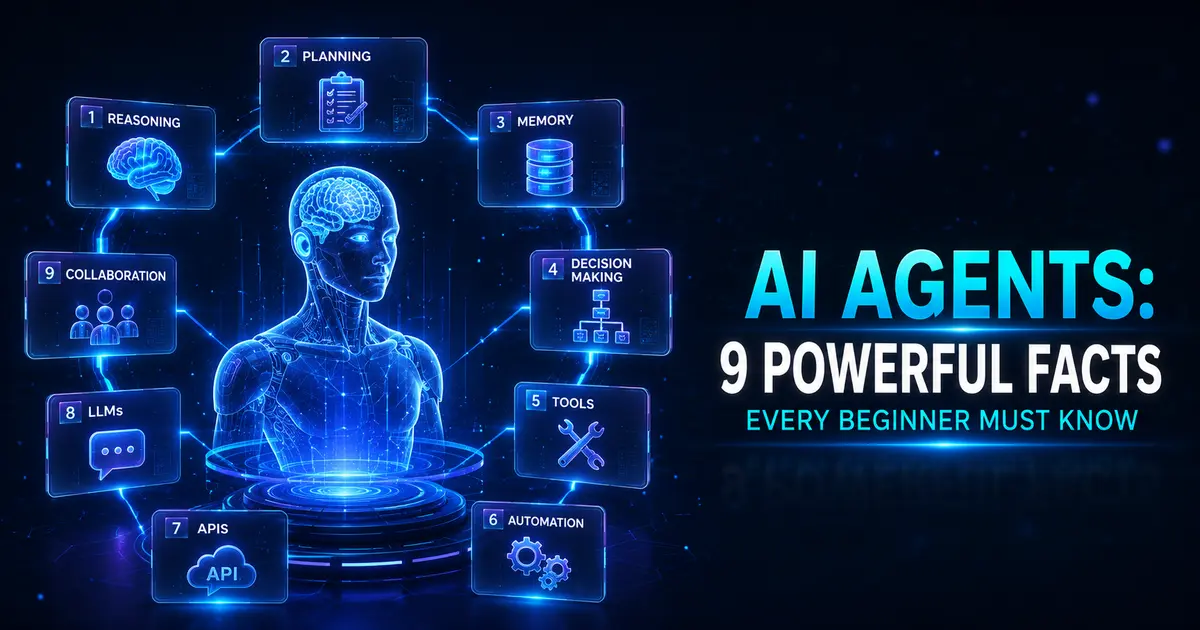
AI Agents are software systems built on large language models that can reason, plan, and take multi-step actions on their own to complete a goal — without a human typing every instruction along the way. If you’ve used a chatbot that only answers one question at a time, an AI agent is the next evolution: it can search the web, call an API, write code, check its own work, and keep going until the task is actually done.
In this guide, you’ll learn exactly how AI Agents work under the hood, the main types you’ll encounter, the frameworks powering them in 2026, and where they’re already being used across real businesses — plus the mistakes that cause most agent projects to fail. If you’re building toward this skill systematically, AI Agents are Stage 6 of our AI Engineer Roadmap.
What Are AI Agents?
AI Agents combine three things a plain chatbot doesn’t have: memory, tool access, and a planning loop. Instead of producing one response and stopping, an agent breaks a goal into sub-tasks, decides which tool or action each step needs, executes it, observes the result, and repeats until the goal is met.
AI Agents vs. Traditional Chatbots
The easiest way to understand AI Agents is to compare them directly against the chatbots most people already know.
| Capability | Traditional Chatbot | AI Agent |
|---|---|---|
| Multi-step task execution | No — single response per turn | Yes — plans and executes several steps |
| Tool/API access | Rare or none | Core feature (search, code execution, databases) |
| Memory across steps | Limited to conversation context | Short-term and long-term memory |
| Autonomy | Fully reactive to user prompts | Can act independently toward a goal |
| Error correction | None built-in | Can observe failures and retry/adjust |
How Do AI Agents Work?
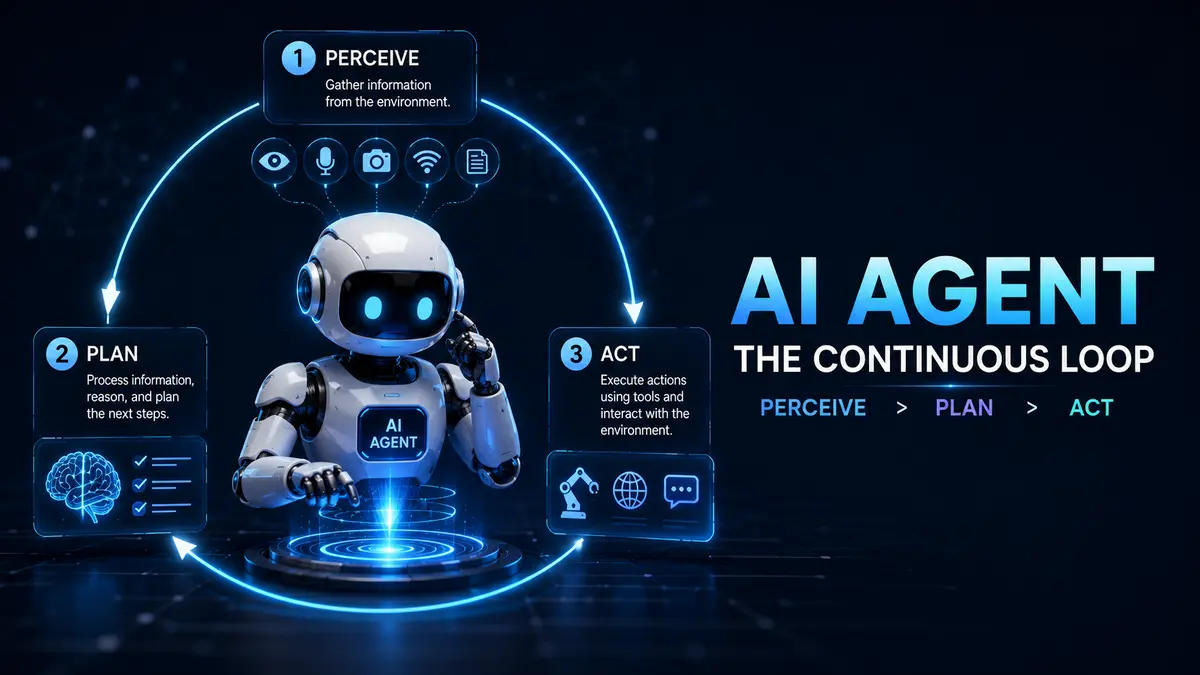
The Core Agent Loop: Perceive, Plan, Act
Nearly every AI agent — regardless of framework — runs a variation of the same loop. Understanding this loop is the fastest way to understand AI Agents at a technical level.
def run_agent(goal, tools, memory):
    while not goal_complete(goal, memory):
        observation = perceive(memory)          # gather current state/context
        plan = reason(goal, observation, memory) # LLM decides next step
        action = select_tool(plan, tools)         # pick a tool or response
        result = execute(action)                  # call API, run code, etc.
        memory.update(observation, plan, result)  # store for next iteration
    return memory.final_output()
This loop — sometimes called ReAct (Reason + Act) — is the foundation behind almost every production AI agent shipping today, from customer-support bots to autonomous coding assistants. If the “reason” half of that loop is new to you, our Prompt Engineering Guide covers the prompting techniques that make it work reliably.
Key Components of AI Agent Architecture
- LLM Core: the reasoning engine (e.g., GPT, Claude, Gemini) that interprets goals and decides next steps.
- Memory: short-term (current task context) and long-term (vector database of past interactions).
- Tools: APIs, code execution environments, search, or databases the agent can call.
- Planner/Orchestrator: logic that breaks a goal into ordered sub-tasks.
- Guardrails: rules and human-in-the-loop checkpoints that keep the agent safe and on-task.
Types of AI Agents
Not all AI Agents are built the same way. Here are the main types you’ll encounter in 2026.
| Type | Description | Example Use Case |
|---|---|---|
| Reactive Agent | Responds directly to input with no internal planning or memory | Simple rule-based support bots |
| Deliberative Agent | Plans multiple steps ahead before acting | Research assistants, coding agents |
| Hybrid Agent | Combines fast reactive responses with deeper planning when needed | Customer service escalation systems |
| Multi-Agent System | Multiple specialised agents collaborate on one goal | Content pipelines (researcher + writer + editor agents) |
| Autonomous Agent | Operates continuously with minimal human oversight | Automated trading or monitoring systems |
Popular AI Agent Frameworks in 2026
Building an agent from scratch is possible, but most teams use a framework to handle memory, tool-calling, and orchestration.
| Framework | Best For | Language |
|---|---|---|
| LangChain / LangGraph | Complex, stateful agent workflows | Python, JavaScript |
| AutoGen | Multi-agent conversations and collaboration | Python |
| CrewAI | Role-based agent teams (fast to prototype) | Python |
| OpenAI Agents SDK | Native tool-calling with OpenAI models | Python, TypeScript |
One of the most significant shifts in 2026 is the rise of the Model Context Protocol (MCP), an open standard from Anthropic that lets AI Agents connect to external tools and data sources in a consistent way — instead of every framework needing its own custom integration.
Real-World Examples and Industry Applications
- Software development: coding agents that write, test, and debug code across a repository.
- Customer support: agents that resolve tickets end-to-end, escalating only edge cases to humans.
- Research and analysis: agents that gather data from multiple sources and produce structured reports.
- E-commerce: agents that manage inventory, pricing, and personalised recommendations.
- Finance: agents that monitor markets and flag anomalies in real time.
Organisations like Google and OpenAI have both published agent frameworks aimed at enterprise automation, signalling how central this technology has become to modern AI strategy.
Benefits of AI Agents
- Automate multi-step workflows that previously required constant human input
- Reduce response time for customer-facing tasks
- Scale research and data analysis beyond human bandwidth
- Connect naturally to existing tools and APIs via MCP and similar standards
- Free up human teams for higher-judgment work
Common Mistakes When Building AI Agents
- Giving the agent a vague goal instead of a clearly scoped task
- Skipping guardrails, allowing the agent to take irreversible actions unsupervised
- Underestimating the cost of repeated LLM calls in long agent loops
- Not testing failure paths — agents need to handle tool errors gracefully
Best Practices for Deploying AI Agents
- Scope each agent to a narrow, well-defined task before expanding its autonomy
- Log every step of the agent’s reasoning for debugging and auditing
- Set hard limits on tool calls, spend, and execution time
- Evaluate agents on task completion rate, not just output quality
Pros and Cons of AI Agents
| Pros | Cons |
|---|---|
| Handles multi-step tasks with minimal supervision | Can be expensive at scale due to repeated LLM calls |
| Integrates directly with tools, APIs, and data | Errors can compound across a long chain of actions |
| Reduces manual, repetitive work | Requires careful guardrails to avoid unsafe actions |
| Improves over time with better memory and context | Debugging autonomous decisions can be harder than debugging fixed code |
The Future of AI Agents
As standards like MCP mature and models get better at long-horizon reasoning, AI Agents are moving from experimental demos to dependable infrastructure inside real businesses. Expect tighter integration between agents and enterprise systems, stronger safety tooling, and multi-agent teams becoming the default way complex work gets automated.
Key Takeaways
- AI Agents combine reasoning, planning, memory, and tool use to complete tasks autonomously.
- Unlike chatbots, agents can take multi-step actions without constant human prompting.
- Common agent types include reactive, deliberative, hybrid, multi-agent, and autonomous.
- Frameworks like LangChain, AutoGen, and CrewAI simplify agent development.
- Tool use and function calling let agents interact with real APIs and data sources.
- Memory systems allow agents to maintain context across sessions and tasks.
- Multi-agent systems divide complex work among specialised, collaborating agents.
- Human-in-the-loop design is critical for safety in production agent systems.
- AI Agents are already transforming support, coding, research, and e-commerce workflows.
- Poor task scoping and missing guardrails are the top causes of agent failure.
- The Model Context Protocol (MCP) is becoming the standard for agent-to-tool connections.
- Agent evaluation should focus on task completion rate and cost-efficiency, not just output quality.
Key Glossary
- AI Agent
- A software system that autonomously perceives, plans, and acts to achieve a goal.
- Agentic AI
- AI systems designed to act with a degree of independence toward a goal.
- Autonomy
- The degree to which an agent can act without human input.
- Large Language Model (LLM)
- A model trained on text data that powers an agent’s reasoning.
- Tool Use
- An agent’s ability to call external functions, APIs, or code.
- Function Calling
- A structured way for an LLM to invoke a specific tool with parameters.
- Reasoning
- The process an agent uses to decide its next step toward a goal.
- Planning
- Breaking a goal into an ordered sequence of sub-tasks.
- Memory
- Stored context an agent uses across steps or sessions.
- Orchestration
- Coordinating multiple steps, tools, or agents toward a shared goal.
- Multi-Agent System
- Multiple agents with distinct roles collaborating on one task.
- ReAct
- A reasoning pattern combining “Reason” and “Act” steps in a loop.
- Chain-of-Thought
- A prompting technique where a model reasons step by step before answering.
- Retrieval-Augmented Generation (RAG)
- Combining a knowledge source with an LLM to ground its answers.
- Vector Database
- A database optimised for storing and searching embeddings.
- Prompt Engineering
- Designing inputs to guide an LLM toward better outputs.
- Fine-Tuning
- Further training a model on specific data to specialise its behaviour.
- Context Window
- The amount of text an LLM can consider at once.
- Hallucination
- When a model generates incorrect or fabricated information.
- Guardrails
- Rules or checks that constrain an agent’s actions for safety.
- Human-in-the-Loop
- A design where a human reviews or approves agent decisions.
- API
- An interface that lets software systems, including agents, communicate.
- Workflow Automation
- Using software (including agents) to run a business process automatically.
- Task Decomposition
- Splitting a large goal into smaller, manageable steps.
- Model Context Protocol (MCP)
- An open standard connecting AI agents to external tools and data.
- Sandbox
- An isolated environment where an agent can safely execute actions.
Frequently Asked Questions
Conclusion
AI Agents represent a real shift from AI that talks to AI that does — reasoning, planning, and acting across multiple steps to complete real work. Whether you’re evaluating frameworks, building your first agent, or just trying to understand where the industry is heading, the core loop of perceive-plan-act is the concept to internalise first. Start small: scope one clear task, add guardrails, and expand autonomy only once you trust the results.